Build the Tool That Makes the Grind Possible
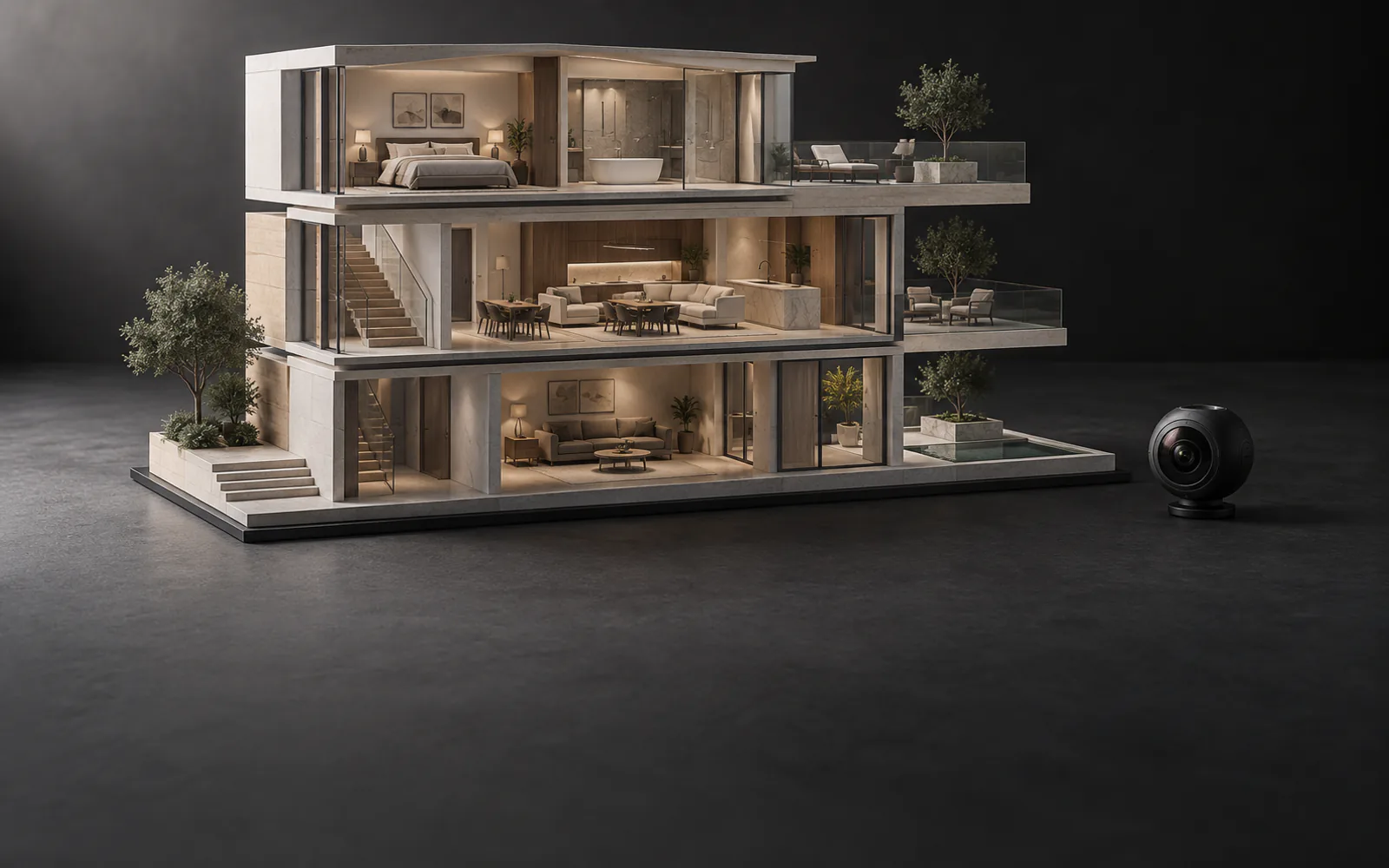
A 360° property tour needs hotspots: the clickable targets that move you from the hallway to the kitchen, from the landing to the main bedroom. Each one is a position on a sphere, expressed as two angles.
The honest way to describe authoring those by hand is: open the viewer, look at a doorway, guess the yaw and pitch, type them into a JSON file, reload, see that you were wrong, adjust, reload. For one hotspot that is tedious. For a two-floor property it is a day you will not get back, and the result is subtly wrong in a way viewers feel as "this tour is a bit janky" without being able to say why.
So before placing any of them, I built a calibrator.
What it does
It is an in-app authoring mode. You aim the camera at the doorway — using the same viewer the visitor will use, so what you see is what they get — click, and it copies the resulting JSON to the clipboard. Paste into the data file. Next one.
It is gated off public builds, so it ships to nobody.
The commit history records what it made possible: 87 markers calibrated across a two-floor property. That number is the argument. Eighty-seven rounds of guess-reload-adjust is not a task someone completes carefully; it is a task someone starts carefully and finishes approximately. The tool is what makes the eighty-seventh hotspot as accurate as the first.
The general case
The instinct that stops people building these is reasonable on its face: the tool is not the deliverable. Nobody is paying for a calibrator. Spending two days on one feels like spending two days not shipping.
The arithmetic usually disagrees. The question is not "tool versus no tool" — it is "two days of tool, then an hour of accurate placement" against "two days of inaccurate placement, then a week of corrections as people notice". And the second branch has a tail: every future property, every client who wants a hotspot moved, every tour added next year pays the manual cost again.
There is a quality argument underneath the time one, and I think it is the stronger of the two. Manual work degrades predictably as it repeats. If the quality of the output depends on a person staying careful through eighty-seven repetitions of something boring, the output will not be good, and no amount of professionalism changes that. Tools do not get bored.
When not to
The test I use: is the work repetitive, or merely long? Long work with judgement in every step does not automate — you will spend the two days and still be making the judgements. Repetitive work where the hard part is precision rather than decision is exactly where a tool pays.
Hotspot placement is the second kind. The decision — "this doorway leads to the kitchen" — takes a second. The precision — "that doorway is at yaw 2.41, pitch -0.08" — is what takes all the time, and is what a machine is better at than you are.
Two days. Eighty-seven hotspots. It was not close.